See if this sounds familiar. You write one post on LinkedIn, it does well with 800+ likes, comments from all the right people, maybe two DMs from prospects. Feeling good, you Google your own name the next day to see how it is showing up. And there is nothing. Not on page one, not on page five.
So where did all that reach go?
This is where I have to disagree with half of LinkedIn. Every second post on my feed is telling bloggers and SaaS founders that LinkedIn content ranks beautifully on Google, better than any other social platform. People are planning entire content strategies around this. And it is mostly not correct.
Let me explain properly, because once you understand what is actually happening, LinkedIn becomes far more useful to you, not less.
The short answer on LinkedIn SEO
LinkedIn Articles — the long-form ones you write in the article editor — do get indexed by Google, usually within 24 to 48 hours. Your profile gets indexed. Your company page gets indexed.
Your feed posts mostly do not.
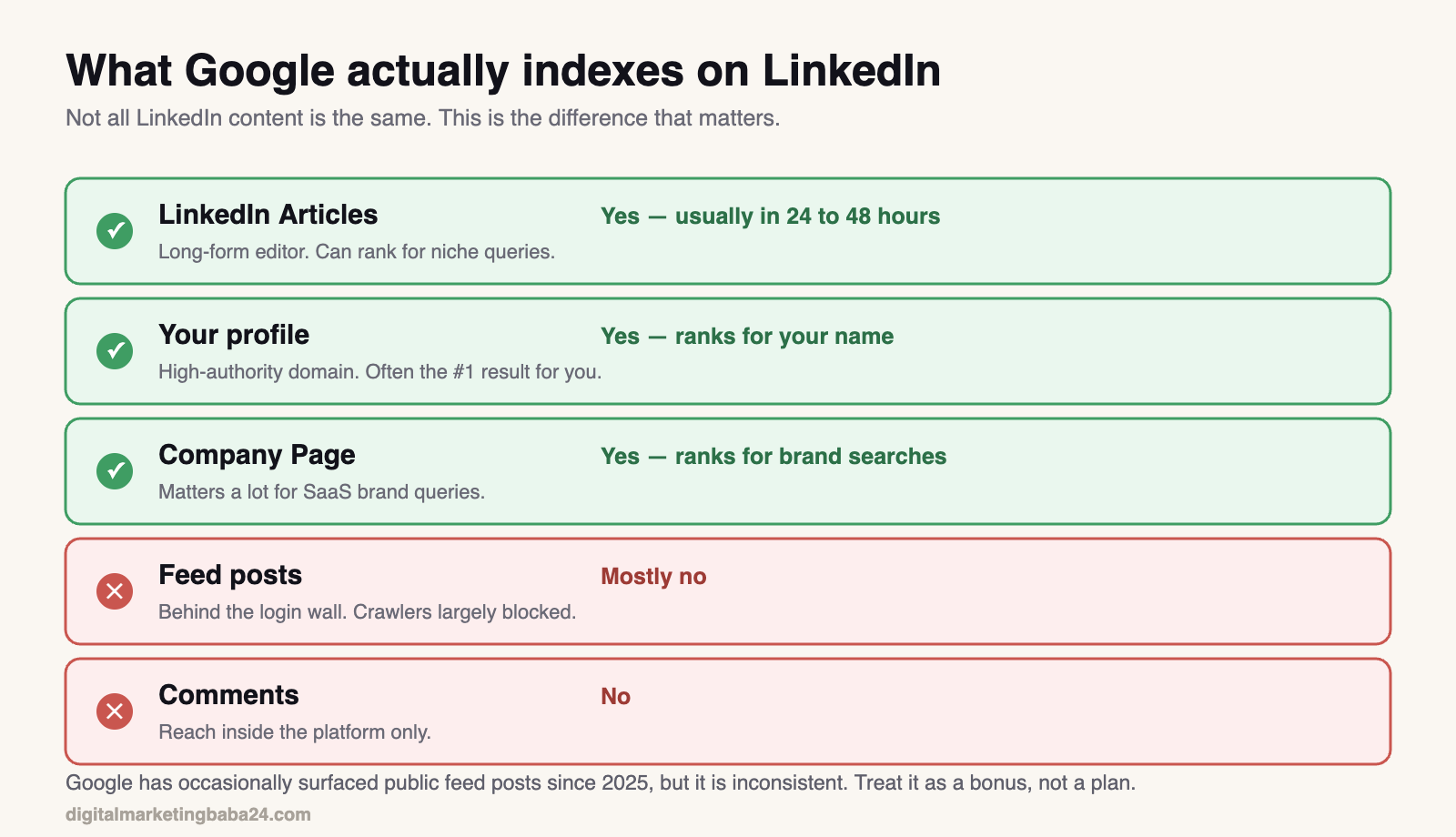
The reason is simple. Feed posts sit behind LinkedIn’s login wall, and LinkedIn blocks a good amount of that content from search crawlers. Your post may get fifty thousand impressions inside the app, but Google often never sees it as a public page at all. It is searchable within LinkedIn. It is not searchable on the open web.
One honest caveat. Through 2025 and 2026 Google has started surfacing the occasional public LinkedIn post in results and AI overviews. It is real, but it is inconsistent. Treat it as a bonus, not as your plan.
And no, LinkedIn does not beat every other platform
This part you must hear clearly, because it is the claim I see repeated most often.
Reddit is currently far more visible in Google than LinkedIn. After Google’s data arrangement with Reddit, threads get picked up quickly and sit on page one for all sorts of commercial queries. YouTube has been indexed heavily for years. If somebody tells you LinkedIn out-indexes everything else, they have simply not checked.
Also, while we are clearing things up — social signals are not a Google ranking factor. Your likes and shares do not push your blog up the rankings. That myth has been alive for a decade only.
Then why is LinkedIn still critical?
Because indexing was never the real mechanism. People got attached to the wrong reason for the right conclusion.
Here is what LinkedIn actually does for a blogger or a SaaS company.
1. It is a search engine in its own right
Your buyer is searching inside LinkedIn. For people, for companies, for solutions, for who else has solved this problem. That search does not touch Google at all. If your profile and company page are written with the words your buyer actually types, you show up in a search Google never sees.
For SaaS this matters doubly, because your company page will rank on Google for brand queries too. When somebody hears your product name in a meeting and Googles it that evening, your LinkedIn page is often sitting right there in the top three.
2. It manufactures branded search
This is the one people miss.
Branded search — people typing your name or your product name into Google — is genuine SEO value. It is high intent, it converts far better than any generic keyword, and you do not have to fight anybody for it.
LinkedIn is very good at creating it. Somebody reads three of your posts over two months, remembers your name, and one day searches for you directly. The post did not rank. The post created the search. Completely different thing, and much more valuable.
3. Distribution is what earns you backlinks
Backlinks are a real ranking factor. Nobody links to a page they have not seen.
When a post lands well on LinkedIn, newsletter writers pick it up, other bloggers cite it, a journalist occasionally slides into your DMs. Those become links to your blog. That is the actual chain — LinkedIn gives you reach, reach gives you links, links move your rankings.
So LinkedIn does help your SEO. Just indirectly, through people, not through crawlers.
4. AI search is reading LinkedIn
ChatGPT, Perplexity and the AI answers in Bing and Google are increasingly pulling from public LinkedIn profiles and company pages. If someone asks an AI tool who the good people in your niche are, your profile is one of the things it can see. This is fairly new and worth keeping an eye on.
5. For B2B SaaS, the audience is simply unmatched
Decision makers are on LinkedIn during working hours in a working mindset. There is no equivalent on any other platform. Even leaving SEO completely aside, this alone justifies the effort.
So what should you actually do?
If you are a blogger
- Publish on your own blog first. That is the asset you own and it compounds for years. Never make LinkedIn the original home of your best writing.
- Then repurpose it as a LinkedIn Article. One idea, two indexed pages. Very little extra work.
- Use feed posts for reach only. Their job is to get seen today and send people to the version you own.
- Put the link where people will actually use it. First comment or the post itself, whichever your reach can afford — but do put it somewhere.
If you are running a SaaS
- Treat your company page as a landing page. It will rank for your brand name, so write the tagline and About section for a buyer, not for your own team.
- Get founders and senior people posting. Personal profiles reach far better than company pages, and they create the branded search discussed above.
- Point your good links at your site, not at LinkedIn. When a publication covers you, the link should go to a page you control.
- Publish original data. One proper research report earns more links in ninety days than six months of guest posting, and LinkedIn is the best place to launch it.
The one line to remember
LinkedIn is not a search engine channel. It is a demand channel that feeds your search engine channel.
Your blog gets you found by people who are already looking. LinkedIn gets you known by people who are not looking yet — and turns some of them into the ones who search for you by name later.
Both are needed. Just stop expecting your feed posts to show up on Google, and go and check whether your LinkedIn Articles and your company page are pulling their weight. That is where the actual search value is sitting, quietly, most probably unused.
If you want to test any of this yourself, do one thing. Search Google for site:linkedin.com followed by your own name. Whatever comes back is what Google can see. Usually it is the profile and maybe an article — and not one single post.
Related: LinkedIn quietly shipped a setting that lets recruiters call your phone.

Ashok Kumar has spent over a decade in marketing, including six years running account-based marketing programmes for B2B teams — working day to day in LinkedIn Ads, Marketo and Salesforce.
He writes Digital Marketing Baba 24 about marketing and AI, martech and SEO: mostly the things he has had to work out himself, with the numbers included.