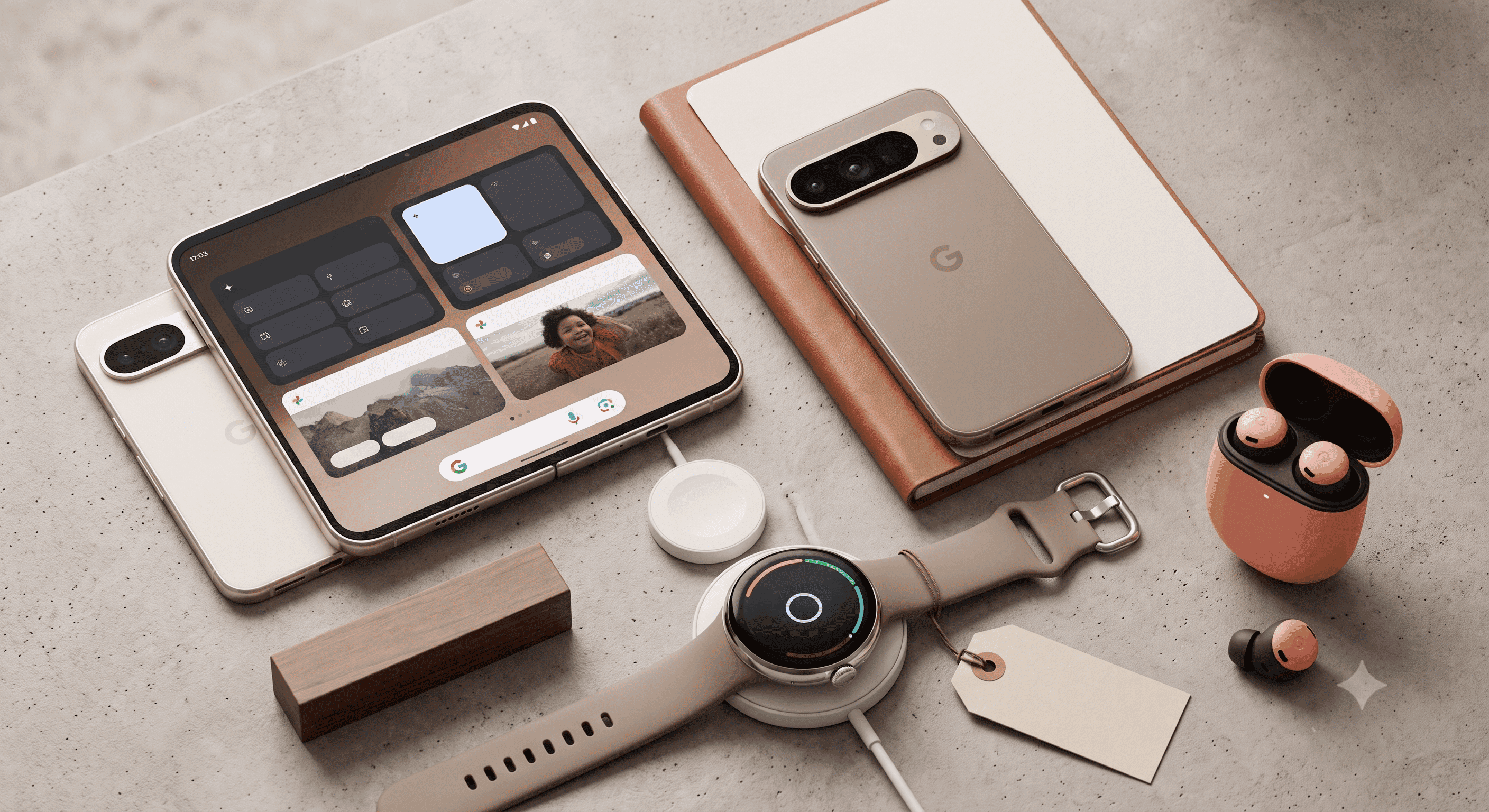
Google has confirmed the date. Made by Google lands on 12 August 2026 in New York, with US preorders opening the same day and retail availability expected around 20 August. Four devices are lined up: Pixel 11, Pixel 11 Pro, Pixel 11 Pro XL and Pixel 11 Pro Fold, with the Fold expected to be shown on stage but not reach shelves until around October.
If you run marketing for a living, your honest first reaction should be: so what. A phone launch is not marketing news, and I have written enough of those posts to know most of them are not worth your time.
There is one thing in this launch worth your attention. It is not the camera.
When is the Google Pixel 11 launching?
12 August 2026, at the Made by Google event in New York City. US preorders open the same day. Retail availability is expected around 20 August, although Google has not formally confirmed a ship date. The Pixel 11 Pro Fold is expected to be announced alongside the rest of the range but go on sale later, around October.
What Google has confirmed, and what is still leak noise
Worth separating these two, because a lot of the coverage this week will not bother.
Confirmed by Google: the event date and venue, the four-device lineup, the new Tensor G6 chip, and Android 17 shipping out of the box.
Still rumour: the 2nm TSMC fabrication process, Gemini Nano v3 running on-device, 12GB of RAM across the range, 256GB base storage, the expanded Video Boost processing, the colours, and every price you have seen quoted. Most of it comes from leakers with decent records. None of it is official until the 12th.
I am labouring the point because within a week you will read a hundred posts stating the rumoured specs as fact. A publication that will not draw this line on something as low-stakes as a phone launch is not one I would trust on anything harder.
The real story: inference is moving onto the device
Strip the handset away and here is what is actually happening. Tensor G6 is reportedly built for one job above all others: running Gemini locally, on the phone, without a round trip to Google’s servers.
That is not a phone story. That is an infrastructure story, and it has been coming for two years.
When inference runs on the device rather than in the cloud, three things change. Less user data leaves the handset, because it no longer needs to. The assistant can act on whatever is on screen without sending it anywhere. And latency drops far enough that AI stops feeling like a feature you open and starts feeling like the layer you work through.
All three are good for the person holding the phone. Two of them are a problem for you.
What does on-device AI do to your measurement?
We have spent five years watching the measurable surface shrink. Third-party cookies, then IDFA, then GA4 modelling more of what it used to count. On-device inference is the next instalment, and it is the largest one, because this time the interaction never touches a server you can instrument at all. There is a precedent worth reading here: how much traffic Google actually sends to websites versus AI systems. The pattern is the same, one layer further down the stack.
The practical version. A customer asks their phone to summarise three product pages and pick one. You get a session with no referrer, no query string, and no way to know the comparison happened. Your dashboard shows direct traffic and a decision you had no sight of.
What should marketers do before 12 August?
Nothing dramatic. Three things worth an hour each.
- Check how much of your traffic is already unattributed. If direct traffic has been quietly growing while your referral sources have not, some of this shift has already started and you have been reading it as noise.
- Write for extraction, not just for reading. An assistant summarising your page needs a clear answer sitting near a clear question. Pages built as one long argument with the conclusion at the bottom already do badly here, and they will do worse.
- Stop treating brand search as a vanity metric. When the interface is an assistant, being the thing someone asks for by name is the most reliable route left to your site.
The honest summary
The Pixel 11 will be a good phone, and for most marketing teams it will be as irrelevant as the Pixel 10 was. What is not irrelevant is the direction it points in: the assistant is becoming the interface, and the interface is moving somewhere you cannot instrument.
Watch the keynote on 12 August for one thing. Not the camera samples. How much of Gemini they say runs with no network connection. That number is the story.

Ashok Kumar has spent over a decade in marketing, including six years running account-based marketing programmes for B2B teams — working day to day in LinkedIn Ads, Marketo and Salesforce.
He writes Digital Marketing Baba 24 about marketing and AI, martech and SEO: mostly the things he has had to work out himself, with the numbers included.


